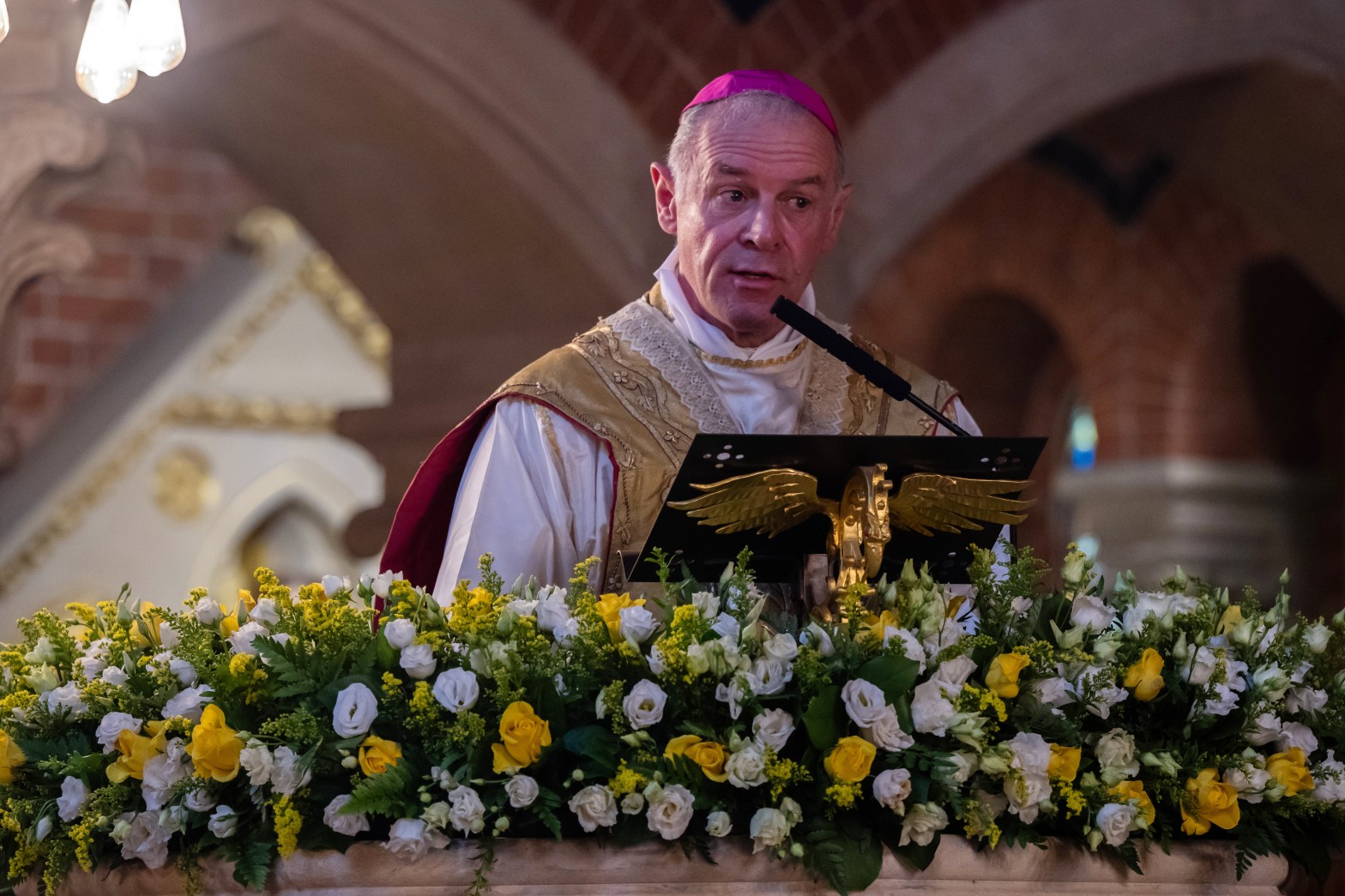
The Rt Revd Paul Mason is the Bishop of the Forces. Ordained in 1998 as a priest of the Archdiocese of Southwark, Bishop Mason was appointed Auxiliary Bishop in Southwark in 2016 by Pope Francis, before being transferred to the Bishopric of the Forces in 2018. He has oversight and pastoral care for all those serving the British Armed Forces around the world. Bishop Mason celebrated a Pontifical Mass on the Solemnity of Corpus Christi on Sunday 7th June 2026.
The power of words.
I worked here for a number of years at St. Thomas’ Hospital as the chaplain, and lots of people tell you lots of things when they’re in hospital. They tell you things perhaps they wouldn’t tell many others when the priest comes.
I remember one chap in particular. He must have been in his fifties. I went to see him, and I was taking him Communion. He told me something of his story. He was quite a pious, regular Mass-goer, and he told me about how, in younger days, he had very, very low self-esteem, a difficult upbringing, and he really had a sense that his point, his place in life, was pointless.
He’d walk quite regularly over Clifton Suspension Bridge, and he’d become very low, suicidal. He told me that one day he thought, “You know, people don’t care. I’m going to jump off this bridge.” He said to himself, “The next person who passes me on this bridge, if they don’t acknowledge me at all, I’m going over.”
And he said, by chance, someone coming the other way—a middle-aged lady—walked by, and she just said, “Good morning,” and smiled. And that was it.
He said to me, “There’s someone on this planet who doesn’t realise that, for two words, I’m still alive. ‘Good. Morning.’”
That’s the power of human words.
Think of the early 2000s. If you remember Michael Howard, it was said about him that there was “something of the night” about him. Now, they were just words, but they stuck. They were powerful words, and they stuck. They didn’t do him a whole lot of good.
What about Churchill? “We’ll fight them in the fields. We’ll fight them on the beaches.” Those words came to identify the spirit of resilience in this country. They were words, but so powerful.
Think of words that we use between each other that can completely and utterly change our lives: “I love you.” “I hate you.” “No, I don’t forgive you.” “The prognosis isn’t good.”
All of those words can utterly change the direction of our lives. The things we say to each other seem like not a whole lot, but they can land.
Psychologists would call this, also, for people in their formative years, the placing of the golden seed – attributed to Freud, but then, isn’t everything? The golden seed: what is that to a young person at a time in their formation, growing up?
Perhaps they hear something positive: “You’re good at sport.” “You’re good at music.” “You’re a good listener.” You can go through your whole life buoyed up by those words that were planted in you early on.
Tragically, of course, it can go the other way. “You’re useless.” “You’re a waste of space.” “You get on my nerves.” If you’re brought up with that, you’ll spend probably most of your life thinking you’re useless and that you get on people’s nerves.
So these are the power of human words.
If our words can make such a difference, then what about God’s words?
“Let there be light,” and there was light.
To the repentant thief: “Today you will be with me in paradise.”
“Lazarus, come out.”
“Peace be with you.”
“Forgive them, Father; they don’t know what they’re doing.”
Those words were not just expressions of something vague. That peace was genuinely given to us. That forgiveness was genuinely given to us. Just as the world came into creation by God’s word, so these things are fundamentally important to us.
The most important words, I suppose, though, are the words on the Feast of Corpus Christi are those of Jesus at the Last Supper.
Now, going back to hospitals: when people know they’re dying, the things they say to the people they love are the most important things they could ever want to say, because they care so deeply.
Knowing he’s going to die, Jesus says, “This is my body. This is my blood.” He means that literally when he tells them that.
So he tells them this, and he doesn’t say to them, “This is to be the symbolic representation of me among you.” If he’d said that, if that’s all he said, then my advice is that on Sunday mornings you just stay in bed.
That’s not what he said.
He said, “This is my body. This is my blood.”
And why do we know he means this in a far more literal way? It’s because of today’s Gospel: “Unless you eat the flesh of the Son of Man and drink his blood, you have no life in you.”
And he meant it in such a way that it drove the crowds away. They kicked off. They thought, “What on earth can he possibly be saying? This is against everything we read in the Old Testament, in Leviticus. This is just not possible: to eat and drink someone’s flesh and blood.”
So he says these things, and they come back to him. They give him the opportunity to say – rather like Sergeant Wilson going to Captain Mainwaring – “Do you think this is wise, sir?”
What does he do? He doubles down. He tells them again. He does not equivocate. He tells them, “Unless you eat my flesh and drink my blood, there can be no life in you.”
St. Augustine, of course, tells us that we are what we eat. When we eat the flesh and the blood of the Son of Man, we take on his divine life. We take it on in a way which makes us roll up our sleeves and live out our vocation side by side with him.
Not some idea, not some philosophy that we’re trying to put out there. It’s the real Lord who has been given to us, the real life of Christ which has been given to us.
We receive Christ in Soul, in Divinity, and in Body. That’s the thing we must remember. It is a real, substantial sharing in the life of Christ.
Thank you, God, for so great a gift.

