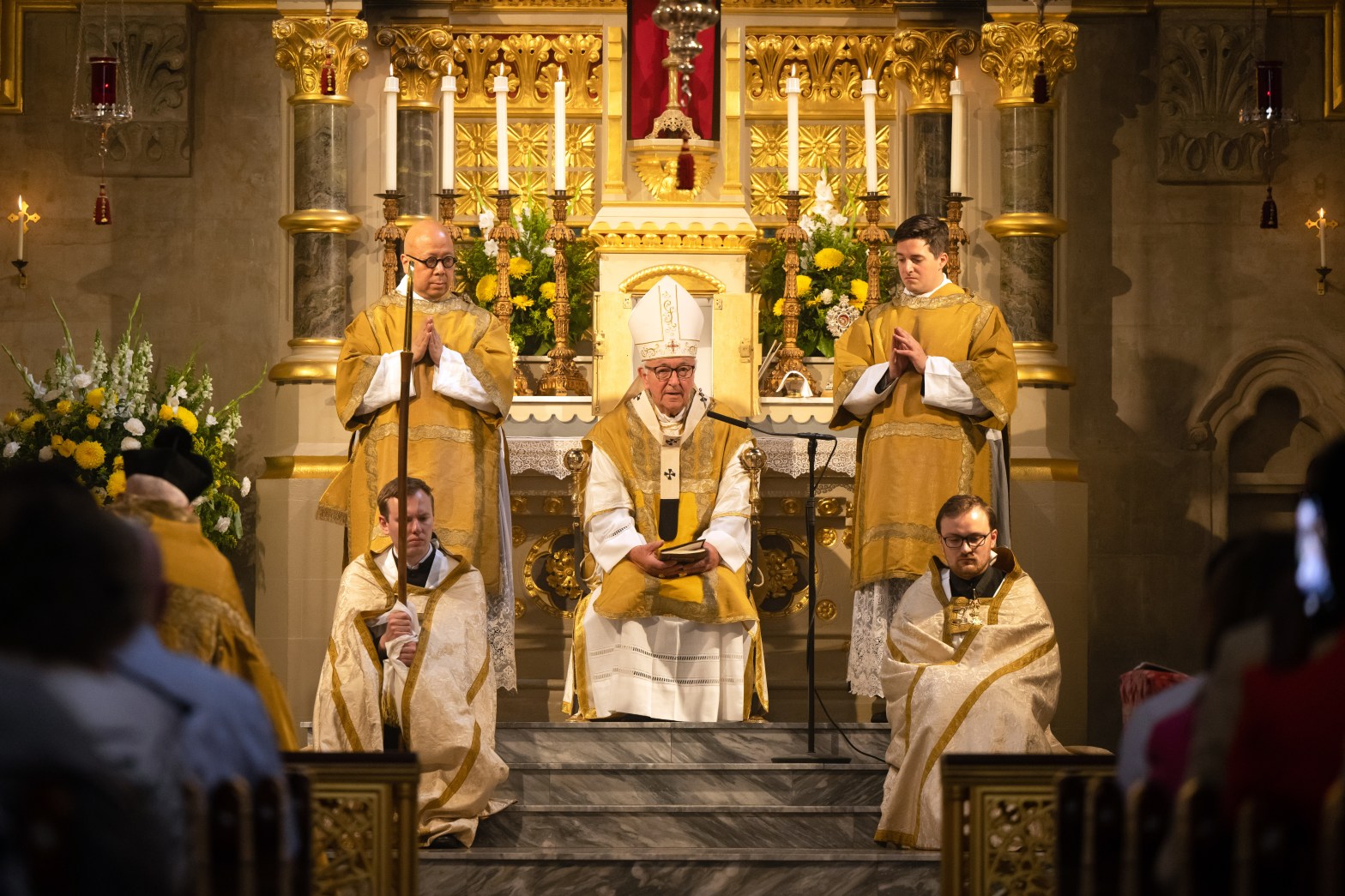
On 11th June 2023, we were delighted to welcome back our Archbishop, His Eminence Vincent Cardinal Nichols, to celebrate our Titular Solemnity of Corpus Christi. The Mass was followed by a Procession of the Blessed Sacrament around Covent Garden.
Just a few moments ago we heard the words of that ancient psalm: “The eyes of all creatures look to You, O Lord”. That’s an expression of an instinct and a longing which is written into every human heart and in the psalmist’s mind found a real focus in the revelation of God to the Jewish people. And today for us it finds an even sharper focus, for all eyes look to the presence of Jesus in the Sacrament of the Most Holy Altar: the Body and Blood of Christ.
There are many different ways of reflecting on this longing and on this revelation. Gregory the Great speaks of the Church as the ‘dawn’ and it’s a very interesting image. I think all of us know what it is to wake up at three o’clock in the morning and be anxious, and to be unsure of what the day will bring and, in a way, waiting for the light of the coming day; waiting for the dawn. That’s where Gregory places us. That, yes, in and through the Church the darkness of the night begins to fade, and the works of Darkness – the darknesses that are in the heart and the conscience of every one of us – can gradually clear. But we in the Church – we here today – we are not the full light of the splendour of the sun in the day. We are still in that mixed zone of light and darkness, and we await the coming of the majesty of Christ in glory. We live with ambiguity. We live with sinfulness. We live in a realm of uncertainty in our behaviour and everything that we see around us.
But as we come before the Lord in this celebration of the Mass, and in his abiding presence in this Sacrament, we come before the fullest of the sunlight. Here is the Sacrament, here is the foretelling of the fullness of life which is our destiny. And that’s why today’s feast has such an important aspect of real hope for us. Yes, here we come fully into this sunlight of Christ. And here we find the warmth and the full splendour of all that we hope for and desire. And before him, like in no other place, we can, as it were, unfold ourselves and present ourselves to him, knowing that his light, his sunlight, can ease the darkness in every crevice of our being. Only before him and in his Sacraments can we receive that great gift.
I would like to suggest that you have this image of us living in the Dawn and yet knowing and seeing in this Sacrament full light of Christ. Have this image as we make our procession after Mass. We bring that Christ – the true light – into the still dusky dawn of our life and world today. Indeed, the very shape of the monstrance suggests that. It is there, almost like a sunburst; a great burst of sunlight. But at its heart is the Sacrament of his Body and Blood.
But this morning we also ought to reflect on from where this procession comes. It comes from here. It comes from the celebration of the Mass. It comes from the way in which the Sacrament creates the Church. Here at this point I would just like to go back to another great figure, maybe the greatest figure, in the Church’s reflection on this feast day: Saint Thomas Aquinas. For it was he who petitioned the Pope to establish this as a feast for the universal Church in the 13th century. To help me and you to just continue this reflection for a moment, I’d like you to look in the Mass booklet that you have, to the hymn that the choir will sing after Holy Communion. What we will hear are the words of the hymn in Latin:
O sácrum convívium!
In quo Chrístus súmitur:
Recólitur memória passiónis éjus:
Mens implétur grátia:
Et futúræ glóriæ nóbis pígnus dátur.
There’s a handy translation on the other side of the page, but I’d like to just deepen that a little bit.
If we take the first line. Here is the Mass described as a ‘sacred banquet’: a sacrum convivium. I think the word convivium is stronger than the word ‘banquet’. As you can see, it brings together two words: ‘to live together’: con+vivere → convivium. So here in the Mass were being bound together into a new life. Another derivation of the word, from this same Latin word, it is convivial: it is joyful. Not because the caviar is good, but because we are being drawn into the very Body and life of Christ himself.
Then the next line: In quo Chrístus súmitur. Now I think that word too can be deepened. When you and I had our breakfast this morning, we ate whatever it was (for me it was Weetabix and a banana, in case you’re interested) but that food, as it were, became part of me and gave me some energy. But when I receive the Eucharist, I become part of Christ, and I am, as it were, absorbed into Christ. He takes me in, a bit like a sponge taking in water. I think that too is an interpretation we can put on to that word sumitur. It’s as if everything is drawn together in him – assumed into him – and it’s a strong image for us to keep in mind.
Mens implétur grátia: our minds are filled with grace. We begin to see the longer horizon of our destiny. No longer do we live just by the horizons of the day’s hope, or today’s news, or tomorrow’s predictions. We live now with a hope that goes beyond those horizons and is certain. The present day is full of uncertainty. A mind filled with grace is full of sure hope in a certain future.
Then the last line: Et futúræ glóriæ nóbis pígnus dátur. It’s translated as ‘a promise is given of our future glory’. We’ll just pause for a moment on the word pígnus. It’s a bit stronger than ‘promise’. It’s a word that means ‘a pledge’. It’s a pledge of love; a pledge of fidelity. Classical Latin uses the word pígnus to describe the children of a loving father and a mother. The children are the pledge of their love, and that’s the strength of what we receive in the Eucharist. We become ‘pledge’, a child, a promise, a manifestation of God’s love for us. St Thomas reflects very beautifully on this mystery of the Eucharist that we celebrate today. I was struck by his starting point. Let me read this sentence to you:
“Since it was the will of God’s only begotten Son that every person should share in His divinity, He assumed our nature.”
God’s purpose is that every single one of us, every created person, will share in the divinity of Christ. And that, as some people like to say today, is ‘awesome’. There is a very interesting reflection, in my mind, on the emergence of Christianity in the Roman Empire.
The question is asked, ‘What ‘new’ did the Christian revelation bring to the Roman Empire?’. Some are tempted to think he was this: it was the promise of divinity. Yet, the Roman Emperor, and the people of Rome, believed that divinity was bestowed upon the Emperor. So the idea that a human person would aspire to divinity was not the great radical newness of Christianity. But he was that the poorest, that the weakest, that the most downtrodden, that the most neglected, the slaves, those imprisoned for no reason… Everyone would aspire and have this pledge of future glory in sharing in the divinity of Christ. This is our faith. This is the faith of the Church. And we are proud to profess it in Christ Jesus. Amen.
 Sodality of the Blessed Sacrament
wow!! 19Cardinal Nichols: O Sacrum Convivium
LikeLike