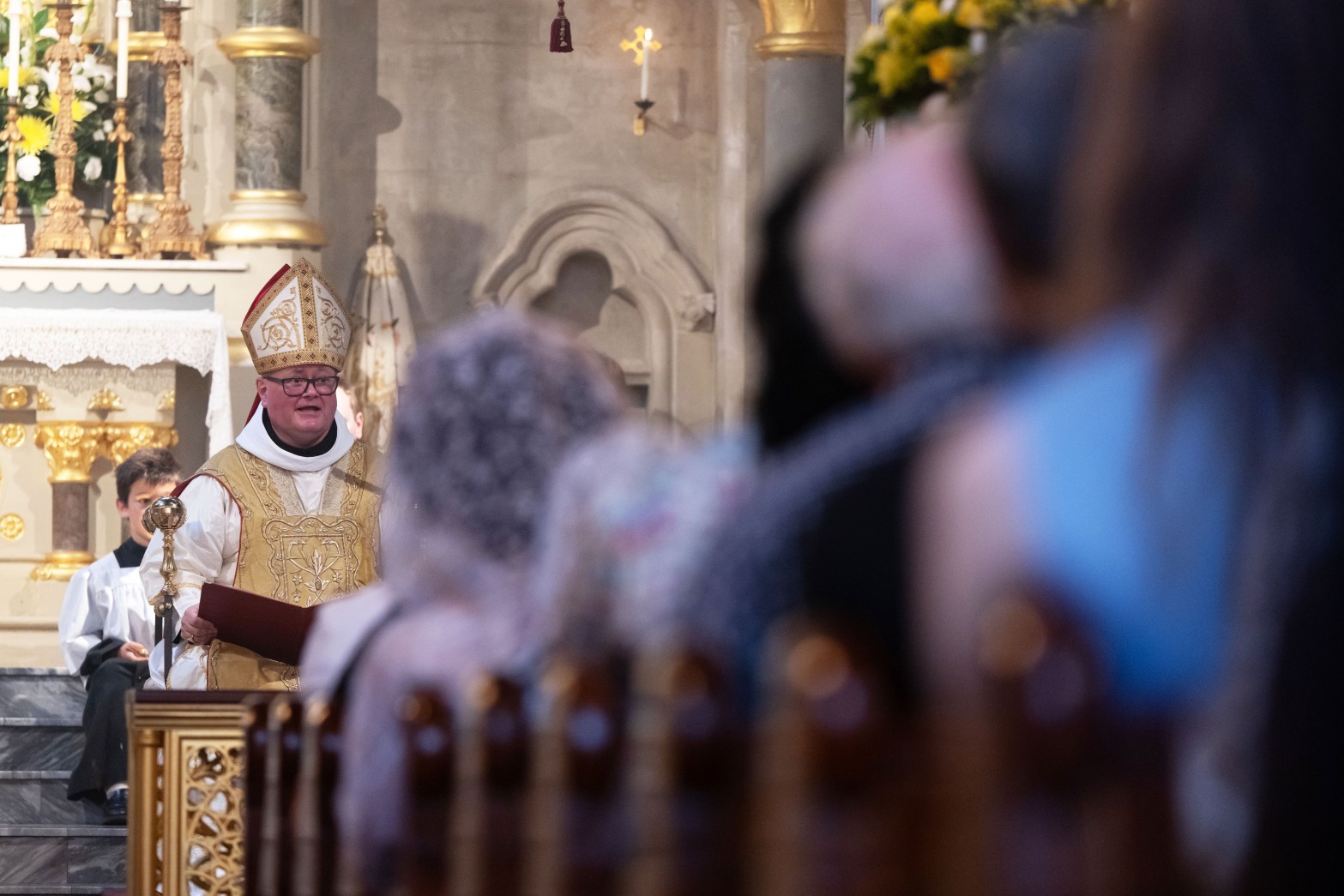
Dom Cuthbert Brogan is the abbot of the Benedictine monastery of St Michael’s Abbey in Farnborough. Founded by the Empress Eugenie of France, the abbey cares for the earthly remains of the Empress, her husband Emperor Napoleon III, and her son the Prince Imperial, Napoleon. Abbot Cuthbert celebrated a Pontifical Mass on the Solemnity of Corpus Christi on Sunday 22nd June 2025.
It is a pleasure and a privilege as always to be invited to this ‘lowly shrine’ which is in fact the glittering gem of Corpus Christi, Maiden Lane, to celebrate with you. And a particular privilege today when so many things come together: the feast of title of this church, the great Holy Day of Corpus Christi, in this year of the jubilee of hope, in which many of our hopes have already been fulfilled: this year of a new pope, this year of the canonisation of Blessed Carlo whose shrine is so loved here, in the shadow of the that of his Eucharistic Lord.
Some years back l travelled to Lebanon to attend the ordination of a friend of mine to the priesthood. He is a priest of the Maronite Rite — one of those ancient churches whose life’ and whose rites adorn the life of the whole church. What l found particularly moving was the ordination itself which spoke so clearly of the mystery of the priesthood. The ordination was not after the gospel as it is with us, but well after the consecration of the host. The bishop placed one hand on the consecrated host and the other on the head of my friend. If you think that is exotic then wait for what comes next!
A portion of the host was placed in the chalice, wrapped in a veil and placed on the priest’s head. From there the priest processed through the church with much incense and many tears and alleluias with the sacrament on his head. l asked about this later and it was explained to me: that the consecration of the priest came from Jesus himself in the host through the ministry of the bishop. Christ’s hand from then on was on the head of the priest, and the priest’s joy and duty was to carrying Christ out amongst his people.
Thinking of this this week made me very excited at the idea of the Eucharistic procession today. Knowing the high reputation that this church and its Rector have for beautiful liturgy and a high degree of sartorial correctitude, I looked to the rubrics for Eucharistic processions – mainly to see what l am supposed to wear! – and I was fascinated by what I found. The old Code of Canon Law told me that this feast is so important that the bishop can be absent from his diocese on this day only for the gravest of reasons, but a book of rubrics from the early 1900s goes on to say how sad it is that such processions cannot take place in protestant England, for although this procession is meant to go into the streets, taking Jesus amongst his people, in Protestant England this was unthinkable except in religious communities which had land and high walls. Indeed at the 1908 Eucharistic Congress the procession was called off because of pressure from the government and even the King: the Eucharist was not carried but procession took plate anyway — some religious came in clergy dress with their habits over their arms in protest, and the benediction was given from the balcony on the front of Westminster Cathedral.
Fr Schofield, the Westminster Diocesan Archivist, writes “Onlookers were fascinated by the exotic attire of the Congress participants: ‘The French priests wear the soutane and black beaver hats; there are monks in black habits, and friars in brown; here and there is seen a red-edged cassock or a douillette; and there are touches of mauve and purple.’ It was as if London had become a Catholic city.”
How things have moved on — we are a still a bit exotic and will still turn eyes as we hit the streets today. One theory of the origin of the procession is very much tied up with the origins of Corpus Christi: the Eucharistic miracle of Bolsena — one of those on Blessed Carlo’s website.
The story goes that a priest in 1263 had lost his faith in the real presence of Jesus in the Holy Sacrament — he took himself of on pilgrimage to Rome and stopped off at Bolsena — one of the pilgrimage route towns. At the consecration of the host a miracle occurred. The Eucharistic bread turned to real flesh in his hands and began to drip blood. Peter tried to conceal the host in the corporal cloth but it dripped onto the altar and its step.
Now nearby in Orvieto the Pope was staying in a place he had there. When news was brought to him of the miracle, he ordered that this corporal be brought to him and so it was in great procession and pomp. Indeed, if you go to Orvieto today you can still see the corporal and the host of the miracle in the Blessed Sacrament Chapel — in Bolsena you can see the stains on the altar where the host dripped blood.
The Pope had a couple of guest friends of his around for lunch — the friends were the Dominican St Thomas Aquinas and the Franciscan St Bonaventure – It must have been quite a lunch! The pope had already been under some pressure to advance a feast of Corpus Christi because of the visions of a Belgian nun St Juliana of Liege — and this pope — Urban IV had been archdeacon of Liege and so was very familiar with Juliana’s visions— and so as Pope needed little encouragement to promote this feast after the miracle of Bolsena. Just as St Paul speaks of being strong in weakness — so our Lord turned the weakness of the faith of this priest into moment of strength for the whole Church.
The pope asked his lunch guests to prepare texts expounding the mystery of the presence of Christ in the host — texts he might use for the liturgy of the new feast. Tradition has it that when St Bonaventure saw the sublime texts of St Thomas Aquinas he tore up his own work. So the feast of Corpus Christi resounds with the glorious poetry of St Thomas Aquinas — the O Salutaris Hostia — the Pange Lingua which he adapted – the Tantum Ergo Sacramentum – the Lauda Sion Sequence from the Mass. These texts, about 800 years old, are the texts of our Mass today. It is a glorious liturgy – it echoes the ‘Thursdayness’ of Maundy Thursday on which the Eucharist was first instituted, even though processions always were held on this Sunday in the Octave of the Feast — it is what the French rightly call Fete Dieu — a feast of God Himself, but the main thrust of this feast was not so much the Mass as the procession, this missionary act of taking Christ out into the street.Our procession might not yet rival the great processions of Catholic Italy or Spain, though I am sure that Fr Robinson has plans! – but ours is adorned with the blood of 105 Tyburn Martyrs who died for the Mass so near to us here. In recent months the secular media has noted with astonishment a resurgence of the Faith amongst young people — young men in particular. In this year of Hope, let us hope for more vocations, for an increase of faith, of reverence and devotion. That, Jesus in the Blessed Sacrament — the Medicine of Life as St Ephrem calls him, may keep his hand upon us and may we be joyful as we lift Him high and carry him out amongst his people today.
 Sodality of the Blessed Sacrament