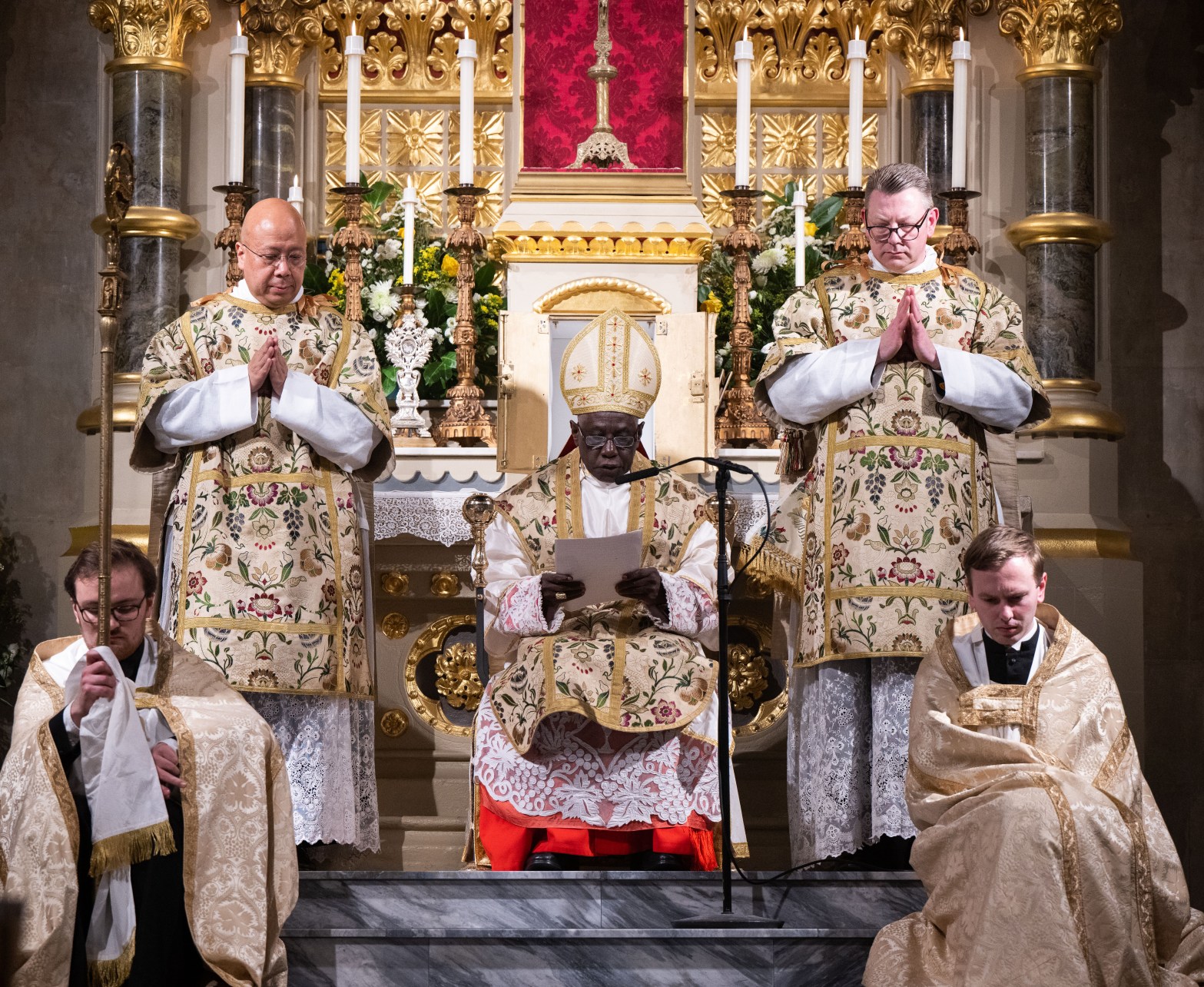
Photo: © Mazur/cbcew.org.uk
His Eminence, Robert Cardinal Sarah was born in Guinea in 1945. In 1957, at age 12, he entered Saint Augustine Minor Seminary in Bingerville, Ivory Coast. The civil unrest in Ivory Coast and Guinea in the following years, he was forced to move from seminary to seminary in order to complete his studies, spending time in Guinea, France, Senegal and Rome. He was final ordained on 20 July 1969.
He was appointed Archbishop of Conakry by Pope St John Paul II in 1979 and served in this position for over 20 years, and suffered under the dictatorship of Sékou Touré. From 2001 onwards, then-Archbishop Sarah served in various roles within the Roman Curia, including in the Congregation for the Evangelisation of Peoples and the Pontifical Council Cor Unum. In 2010, he was elevated to the Sacred College of Cardinals by Pope Benedict XVI and in 2014, Pope Francis appointed him Prefect of the Congregation for Divine Worship and the Discipline of the Sacraments. He served in his post until his retirement at the age of 75.
The following homily was preached on the Solemnity of All Saints 2022.
The French novelist, Léon Bloy, writes: “The only real sadness, the only real failure, the only great tragedy in life, is not to become a saint.” This is the unwavering call that the Church makes to all people throughout the ages. It comes from Jesus Himself, who ends His most important and longest of teachings, The Sermon on the Mount – a part of which has just been proclaimed – with the call to His disciples: “Be perfect, as your heavenly Father is perfect” (Mt 5:48). Through His Paschal Mystery – His suffering, death, resurrection and ascension – Jesus gives us the grace to be perfect through the gift of the Holy Spirit. And, most particularly, for us, consecrated persons. As Cardinal Basil Hume once said: our people are right to expect their Bishops and their priests to be holy. They know, by a very sure instinct, that we are concerned with sacred things. We stand every day at the Altar and use a form of words that identifies us in a remarkable way with the Lord Jesus Christ Himself. Ours is an awesome responsibility.
In the centuries that followed the summons of Jesus, the Fathers of the Church repeatedly called Christians to holiness, as did the Councils of the Church. In its “Universal Call to Holiness in the Church” (Chapter V of the Dogmatic Constitution Lumen Gentium), the Second Vatican Council states:
“All the faithful of Christ of whatever rank or status, are called to the fulness of Christian life and to the perfection of charity … In order to reach this perfection, the faithful should use the strength dealt out to them by Christ’s gift, so that … doing the will of the Father in everything, they may wholeheartedly devote themselves to the glory of God and to the service of their neighbour”.
(n.40§2)
Saint Pope John Paul II, who raised to the Altar more saints than any of his predecessors, refers to holiness as “the prime and fundamental vocation” that God the Father assigns to each of us. “Holiness is the greatest testimony of the dignity conferred on a disciple of Christ” (Post-Synodal Apostolic Exhortation Christifideles Laici, n.16). When Pope Emeritus Benedict XVI spoke to young people here in London on the steps of Westminster Cathedral, dedicated to the Most Precious Blood of Our Lord Jesus Christ, he told them exactly what holiness consists of. I quote:
“Think of all the love that your heart was made to receive, and also the love it is meant to give. After all we were made for love, This is what the Bible means when it says that we were made in the image and likeness of God; we were made to know the God of love, the God who is Father, Son and Holy Spirit, and find our supreme fulfilment in that divine love … We were made to receive love … We were also made to give love, to make IT the INSPIRATION for all we do, and the most enduring thing in our lives”.
(18 September 2010)
In our own times, Pope Francis has offered compelling words on the call to holiness in his Apostolic Exhortation Gaudete et Exsultate, dedicated entirely to the theme of holiness in today’s world: “The Lord asks everything of us, and in return he offers us true life, the happiness for which we were created. He wants us to be saints and not to settle for a bland and mediocre existence” (n.1).
From the teaching of Jesus onwards, the message is clear. We are called to be saints. Countless holy persons over the ages have attested to this. “God would never inspire me with desires that cannot be realized,” Saint Thérèse of Lisieux writes, “so in spite of my littleness, I can hope to be a saint.” But, looking at ourselves – our weaknesses, failures and sins – we might well ask, how?
Today’s Solemnity of All Saints, the Readings of the Mass, and this most beautiful of churches, dedicated to the Body of Christ – Corpus Christi, the Diocesan Shrine of the Blessed Sacrament – offers us the answer. In the stain glass window of the Sacred Heart Chapel here, we find embedded Saint Margaret Mary Alacoque. In His apparitions to this seventeenth century Visitation Sister, Jesus spoke of His Eucharistic presence as the “Sacrament of Charity,” such that Saint Margaret Mary could affirm: “Jesus is found in the Sacrament of the Eucharist, in which love keeps Him tied like a victim, always ready to be sacrificed for the glory of His Father, and for our salvation.”
Indeed, in the Eucharist, God becomes body given out and flesh poured out in Christ in such a way that we, who receive Him worthily, are given the grace to enter into the very dynamic of His self-giving. In today’s Second Reading, we hear what is our true nature: “See what love the Father has bestowed on us that we may be called children of God. So we are!” The one who accepts that “God loved us first” answers with the gift of love: “We love because He first loved us” (1 Jn 4,19).
Such love becomes visible in the men and women who reflect His presence in the world through self-giving. These are the martyrs, so many of whom fecundated this nation with their blood in defence of the Catholic faith and the Eucharist, “washing their robes in the blood of the Lamb.” They are the saints. So many of them fill this Shrine – Saints Joseph, Clare, Jean Vianney, Mary Magdalene – to name just a few. The martyrs and saints allow themselves to be taken up in this primordial initiative of God and witness to charity as a giving of self, that is, in love of God, neighbour and even one’s enemy.
Saint Thérèse of Lisieux is one of the many saints whose statue adorns this Shrine. As she reached the end of her short life of just 24 years, she says this: “Your will is to love in me all those that You command me to love! Yes, I can feel it – when I am charitable, it is only Jesus acting in me; the more I am bound to Him, the more I love my sisters.” In times so heavily clouded by “darkness and the shadow of death” (Lk 1, 79) – attacks on life in the mother’s womb to the disabled and elderly, the merciless ending of life through euthanasia, the disintegration of the family through divorce and gender ideology, war and barbaric violence – how much we need saints, who experience God’s love and allow His self-giving love to the end to enter this world as light!
Dear brothers and sisters in Christ: let us dare to be saints who live and draw grace from the Eucharist! Just a few weeks ago, dear Father Alan, you dedicated a Shrine to Blessed Carlo Acutis. “The only thing we have to ask God for, in prayer,” he would say, “is the desire to be holy.” He knew that the “highway” to holiness was the Eucharist. He would say: “The more we receive the Eucharist, the more we will become like Jesus, so that on this earth we will have a foretaste of Heaven.” And what is Heaven if not living with Jesus in the joy of the Trinity and in the company of the Blessed Virgin Mary, the Angels and the Saints? In communion with them on this Solemnity of All Saints and in this hidden gem of the Shrine of the Blessed Sacrament, we prostrate ourselves before the throne, worship God, and exclaim: “Blessing and glory, wisdom and thanksgiving, power, and might be to our God forever and ever. Amen.”
 Sodality of the Blessed Sacrament
One thought on “His Eminence, Robert Cardinal Sarah: All Saints 2022”